

Plant Tissue Testing
Plant tissue analysis complements soil testing by showing what the plant actually contains, so nutrition programs can be adjusted before deficiencies reduce production.
Plant Tissue Testing
Plant tissue analysis is a monitoring tool that complements soil testing. It lets farmers adjust nutrition programs based on what the plant actually contains.
It helps determine when to apply nutrients, confirms the right balance among nutrients, and identifies possible trace-element deficiencies before they reduce production.
Correct sampling is essential for accurate results. Sampling guidance comes with the testing kits or from your local Plantations International agronomist.
For a free initial consultation, or to learn more about plant tissue testing services and kits, call +852 5808 3775 or use the contact page.
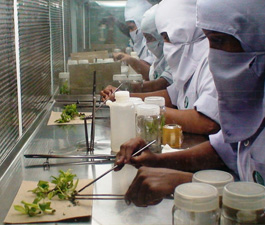
How tissue testing works
- 1. Sampling: Plant tissue is collected following the guidance supplied with the kit or by your agronomist.
- 2. Analysis: The tissue is dried and analysed for major elements (for example, nitrogen) or trace elements (for example, zinc).
- 3. Comparison: Results are compared with ideal levels for the same crop at the same growth stage, based on decades of research.
- 4. Recommendations: Plantations International interprets the results and makes recommendations.
Soil Testing
Understanding soil characteristics is essential for optimal land use. Soil pH is one of the most important measurements. It affects nutrient availability and the presence of toxic ions such as aluminium. pH readings can indicate possible acid sulfates, exchangeable hydrogen, soluble salts or high sodium (alkali soil).
A soil test analyses a sample for nutrient and contaminant content, composition, acidity or pH, and other traits. It shows fertility, expected growth potential, nutrient deficiencies, toxicity risks from excess fertility, and inhibition from non-essential trace minerals. The test mimics how roots absorb minerals, and expected growth is modelled using the Law of the Maximum.
We recommend 10-20 sample points per 40 acres of field. Because nutrients vary with depth and change over time, both sampling depth and timing can affect results.
Soil from several locations can be combined into a composite sample before analysis. This is common but should be done carefully to avoid skewing results, and it must meet government sampling requirements. A reference map should record the location and quantity of each sample so results can be interpreted correctly.
Plant nutrients our laboratories test for
Our laboratories test for plant nutrients in three categories. Results guide fertiliser composition and dosage for agricultural and horticultural land.
- Major nutrients: nitrogen (N), phosphorus (P), potassium (K)
- Secondary nutrients: sulfur, calcium, magnesium
- Minor nutrients: iron, manganese, copper, zinc, boron, molybdenum, chlorine
Related links
Farmers Are The Backbone of Society
Talk to our plantation team about developing, managing or owning a sustainable farm or orchard.