

Drip Irrigation Systems
Drip irrigation saves water and makes efficient use of manure and fertiliser by delivering water slowly to plant or tree roots. Plantations International selects the system to suit your land, soil, water and crop.
Drip Irrigation Systems
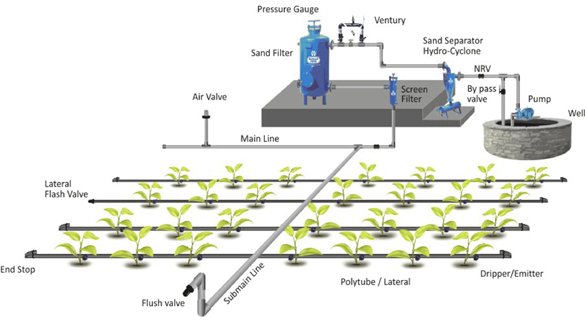
Drip irrigation saves water and uses manure and fertiliser efficiently by slowly delivering water to plant or tree roots, either on the soil surface or directly to the root area. It works through valves, pipes, tubing and emitters that deliver water through narrow tubes to the base of the plant. Systems may also use micro-spray heads, which spray a small area instead of dripping. These suit tree and vine crops with wider root zones.
Where water is scarce or recycled water is used, Plantations International uses subsurface drip irrigation (SDI), with dripper line or drip tape buried at or below the root zone. System choice depends on land topography, soil, water, crop and agro-climatic conditions.
Drip systems suit commercial greenhouses, residential gardens, polyhouses, shade nets, hydroponics and open fields. Large systems usually include filters to keep waterborne particles from clogging emitters, and newer systems resist clogging better. Home drip kits, which include a timer, hose and emitter, are growing in popularity.

Main Components of a Plantations International Drip System
- Pump
- Filtration: water filter, sand filter (separator) and fertigation systems (mixing liquid fertiliser into irrigation water)
- Pressure controller (pressure control valve or regulator)
- Backflow prevention unit
- Large main line pipes and pipe fittings
- Hydraulic control valves and safety valves
- Small-diameter poly-tube laterals
- Poly fittings and accessories for drip connections
- Emitters or drippers, micro spray heads, in-line drippers or in-line drip tube
Advantages of Drip Irrigation
- Useful where water availability is a major problem
- Can increase yield and speed crop maturity
- Reduces fertiliser and nutrient loss through localised application
- Uses water very efficiently
- Makes intercultural operations easier
- Distributes water uniformly to the plant root zone
- Controls weeds and soil erosion
- Works well on irregularly shaped land
- Allows recycled wastewater use without issues
- Saves labour compared with other irrigation methods
- Reduces the risk of plant- and soil-borne diseases
- Operates at lower pressure, which may cut energy costs
- Requires no land levelling
- Keeps root-zone moisture constant through uniform distribution
- Allows fertigation with minimal fertiliser or micronutrient waste
- Output is easy to control through valves and drippers
- Soil type plays a minimal role in irrigation frequency
- Saves time and money overall
Drip Irrigation vs Sprinkler Irrigation
Drip irrigation compares favourably with sprinkler irrigation, which has these disadvantages:
- Uneven water application caused by wind and extreme temperatures
- Water loss through evaporation during irrigation
- Wetting of foliage, which raises disease and fungal risk
- Improperly set spray angles near buildings and walkways can damage fixtures
Cost of Drip Irrigation for Farmers
Drip irrigation delivers water to the root zone through emitters on a pipe network. Emitting devices include drippers, micro jets, misters, fan jets, micro sprinklers, mini sprinklers, micro sprayers, foggers and emitting pipes, each designed to discharge water at set rates. The choice depends on water requirement, plant age, spacing, soil type and water quality.
Micro-tubes are sometimes used as emitters, though they are inefficient. Surface and subsurface systems both fall under micro irrigation. Contact us for an indicative list of components and costs for installations of 0.4 to 5 hectares.
Subsidies on Drip Irrigation Systems
Subsidy information applies only to Indian farmers and growers. Others should contact their local horticulture or agriculture departments. Central and state government schemes offer drip subsidies in India, which vary by state and landholding size.
- Marginal farmers (up to 2.5 acres dry or 1.5 acres wet): up to 90% subsidy
- Small farmers (up to 5 acres dry or 2.5 acres wet): up to 90% subsidy
- Other farmers (above 5 acres dry or 2.5 acres wet): 60% to 80% subsidy
Farmer Subsidy Eligibility Requirements
Subsidy allocation follows these targets, with preference given to small and marginal farmers, SC/ST/BC farmers and women farmers.
- 16% of the total financial target is covered by Scheduled Caste farmers
- 55% of the total financial target is covered by Scheduled Tribe farmers
- At least 25% is covered by BC farmers
- At least 50% is covered by small and marginal farmers (SF/MF)
- No more than 10% is covered by other farmers (holdings over 5 acres)
Free initial consultation
Call +852 5808 3775 for a free initial consultation, or use the contact page to reach your nearest representative.
Related links
Farmers Are The Backbone of Society
Talk to our plantation team about developing, managing or owning a sustainable farm or orchard.